MUSINGS & ARTICLES


The Wheel Turns ... is a series of articles I am in the process of writing for the magazine The Essential Herbal.  At this point, several of the articles have been published, and you can read them below.  As I write new articles for the series, I will add them to this page.    You can click on these links to get to the beginning of each article.  Yule, or Winter Solstice, Imbolg, Vernal Equinox, Beltane, Litha into Lammas.   

There is also an article I wrote on using labyrinths as a tool for walking between the worlds, which was published in the Reclaiming Quarterly.

Any of these articles are available for reprint, if you obtain my written permission.  Send me a letter, email me, or telephone!


Recently, I've been thinking about the question of whether it is ethical to offer sacred herbs for sale.  I know that there are some First Nations elders who do not approve of the sale of sacred plants, but there are also many who do approve, so long as every step of the process is handled in a respectful and sacred manner.  I procure several herbs for smudge, tea and smoking from Native peoples, and feel quite sure that the harvesting and bundling is done with pure heart and appropriate prayers.  I continue to handle the herbs in a sacred manner.  For me, "selling" is a form of energy exchange.  It's the easiest one for most people to use, but it certainly isn't the only possibility.  And I think that it is important for the exchange of energy to move in both directions, just like breath.  Inhale, exhale. Give, receive.


THE WHEEL TURNS*

… TO WINTER SOLSTICE, OR YULE


Yule is an old name for Winter Solstice, which falls between the 20th and the 23rd of December each year.  This is the longest night of the year, and the shortest day.  It is as dark now as it will get to be this year.  The sun’s arc stays low, closer to the horizon, and some days it hardly seems to get light. The darkness gives us time to rest, and offers the perfect opportunity to look inside ourselves.  Our ancestors learned to stay home, close to the fire, and to do the work of Winter.  Fixing and mending.  Even today, many people hold a vigil at their hearths, telling stories & singing songs to keep themselves awake through the long night, waiting for the morning birth of the sun. The Yule celebration is to remind us of the promise of life that is hidden in this time of slumber.

We’ve seen the first snow flurries.  They warn of what is to come.  The noisy flocks of Canada Geese have flown south; some days their honking seemed almost constant, and the songbirds have followed their call.  It’s grown quieter here.  I am grateful for the company of juncos and titmice and chickadees.  I offer seed and conversation, careful not to miss a single day.  The air is cold, and at the edge of the labyrinth garden, the bony arms of the old oak tree spread across a grey sky.  Winter comes.  I am ready.


The last of the harvesting was completed before Samhain, and since then I have cleaned out the gardens and laid down a layer of mulch on the paths in the labyrinth.  “Putting the garden to bed”, I call it.  I look over it lovingly from the upstairs windows, but I don’t go into the garden as much these days.


Now, the work has moved indoors.  The kitchen and pantry are full.  Most of the dried herbs are in jars, though a few bundles still hang in the attic.  The oils are infused and ready for salve and soap making.  The first batch of delicious and beautiful Elderberry syrup is in the refrigerator, waiting for the times when it is needed.  This year, I have more Elderberries than usual.  I’ve even frozen some & will make fresh batches as they are needed through the cold season.  I add pieces of Astragalus root to every pot of soup, as well as taking Astragalus tincure every day, to help keep our immune systems strong.


Our house is decorated with pine and holly boughs, ever green with the promise of ongoing life.  And we have lots of candles, mostly beeswax, though I’m trying some soy candles this year as well.  No paraffin for me though!  (It’s a petroleum product.)  Dried grapevine & strings of tiny white lights form a faerie bower on the front porch. A fire burns in the fireplace most days.  When I light the fire, I toss a handful of dry herbs into the fire after making my prayers for the day.  Lavender, cedar & sage are my favorites for this.  The smoke from the burning herbs carries my dreams & hopes out to the multiverse.  Simple rituals enrich my daily life.

So many of the Christmas traditions that surround us actually come from the older Yule celebrations.  Understanding the deeper meanings can help us to slow down and feel the joy and purpose in this time.  The evergreen trees that we bring into our homes & decorate are, of course, reminders of the continuation of life through the long winter.  The mistletoe was the most sacred of plants to the Druids, its name meaning “all heal”.  The Yule log is another reminder of the importance of fire through the winter & is traditionally cut from a fruit tree, to ensure fertility of the orchards.  Santa is descended from the village shamans, or healers, who developed the ability to travel between the worlds bringing back healing gifts to humans from the Otherside.  Even the story of a Divine Child born at Winter Solstice is a common theme.  Mithras (Rome), Horus (Egypt), Apollo (Greece) and Tammuz (Mesopotamia) are all miraculously-born gods whose annual arrival is celebrated with the birth of the sun, at Winter Solstice.  If you are interested in learning more, an excellent book is The Winter Solstice by John Matthews.


So, keep warm and be well.  See you by the fire!

copyright Sarah Campbell, 2004


* “The Wheel Turns…” refers to the Wheel of the Year, an image of the solar year as a wheel with 8 spokes representing the two Solstices, the two Equinoxes, and the four “cross-quarter” days, which are midway between each Solstice and Equinox.  Many earth-based traditions and cultures use similar versions of this concept.


Return to TOP


THE WHEEL TURNS*

… TO IMBOLG

Imbolc, or Imbolg is a word with Gaelic origins meaning “Ewe’s milk” or “in the belly”.  The lambing season begins and the ewe’s milk begins to flow again.  The goddess Brigit, or Bridgid, or Bride is so important to the peoples of the British Isles that they refused to give her up when the Romans invaded (only a few hundred years ago, really!) The church incorporated Her into their conquering religion, calling Her “Saint Brigit” in an effort to encourage the people to convert to the new religion.  The Hebrides Islands are named for Her, our ancient goddess, and probably Britain itself!  Imbolg is Her most sacred day; some even call the day Brigid.  She is the Bride of Spring! 

February 2nd

 It is before dawn on Imbolg morning.  The garden seems to sleep under a blanket of snow.  There is a soft, shadowy outline of the labyrinth, the ancient core of my garden, lies waiting.

 My husband has already departed for the Groundhog Day festivities.  I know that the celebration will be raucous and fun.  The tongue-in-cheek humor, and the crowd that gathers, will have the feel of a simpler time.  But, I choose to stay home…

 This day is sacred to me.  I already know the answer to the question they will be asking the groundhog.  Today it is six and a half weeks until Spring Equinox, six and a half weeks since Winter Solstice.  This is the mid-point.  I know that although we are still in the coldest part of the winter, we are, without a doubt, moving toward Spring.

 Hope Springs Eternal!

 I know that even in the frozen soil, seeds are preparing to stir.  It will only take one or two warmer, sunny days and the snowdrop bulbs will push green tips toward the sun.  Life reaching for Life.

 This morning I will stay home, gathering the last signs of winter and the old year from around my house.  The last of the evergreen boughs on the mantle will go into the fireplace.  The sculpture of the wild stag that stands as the centerpiece on the dining room table will be put away until next Winter begins.  I will clean my altar, and gather the spell bundles and charms that have collected there since last Imbolg.  They, too, will go into the fire, and be released to the Elements. 

 This is the way I begin my Spring Cleaning, and the fire is to honor Bridgid, the ancient goddess of Fire.  Some say She is our original Fire ancestor.  I ask Her to protect all of the fires in my home - the hearthfires, the furnace, the water heater, stove and dryer, the toaster and the iron, the candles.  She blesses the sparks of creative thought in my mind, and is the source of healing energy in my hands.  All of this comes from Fire.

 Amazingly, She is also Keeper of the Holy Well.  I have come to believe that every place that water springs to the surface of the earth is one of Bridgid’s Wells.  Fire and Water, the source of life.

 Today, especially, I will honor her.  I will sing to her:

             Holy Well and Sacred Flame

                Bridgid, I invoke your name.

                Bless my hands, my head, my heart.

               Source of healing, song and art.**

 The snow covers the ground, but already Spring begins to grow in my heart.

 * “The Wheel Turns…” refers to the Wheel of the Year, an image of the solar year as a wheel with 8 spokes representing the two Solstices, the two Equinoxes, and the four “cross-quarter” days, which are midway between each Solstice and Equinox.  Many earth-based traditions and cultures use similar versions of this concept.

copyright 2004, Sarah C. Campbell

 **Song written by Diane Baker and Anne Hill


Return to TOP


THE WHEEL TURNS*

… TO THE VERNAL EQUINOX

The Vernal, or Spring, Equinox falls on March 19 this year.  Day and night are equal in length.  The Germanic tribes called this day Eostar or Eostre, and it was held to be sacred to the goddess, also named Eostar or Ostara.  Her sacred animal is the rabbit, and symbols of the holiday are baby animals, eggs and seeds.  Sound familiar?  In Greek mythology, the vernal equinox is the day that Persephone returns from the Underworld.  She and her mother Demeter dance together in joy at their reunion, and wildflowers bloom everywhere they step!

 March 19. 

 The long winter is over!  Today everything hangs in the balance of the equinox.  My garden has begun to show its first treasures.  Hundreds of snowdrops hand their pearly blossoms underneath the still-sleeping cherry tree.  Purple and yellow crocuses show their color in the sunniest spots.  Soon daffodils and hyacinth will blossom, filling the air with their sweet fragrance.  The chamomile offers a bright green blanket along the edge of the labyrinth, the ancient core of my garden.  The chickweed runs rampant, and I will make pesto from it every few days.  The promise of Spring is fulfilled, and our hearts are filled joy and anticipation.  It may still snow on my garden, but it won’t stay long, and it will serve to encourage the wild onions to grow.  Yum!

 This is a sacred day for me, a day to meditate on the brief moment of balance as we move from a time of darkness to a time of light.  Custom says that an egg will stand on its end at the moment of equinox, but I’ve never been able to do it!  The most common symbol of this holiday is the egg, which represents new life.  We color our eggs with simple plant dyes – beets for red or pink, carrots for orange, onion skins or turmeric root for yellow, spinach for green, blueberries for blue, blackberries or grape juice for purple.  These colors tend to be much softer than the commercially available ones.

 Another favorite vernal equinox ritual is the magical planting of seeds.  When I start seeds indoors, I meditate on my hopes for the coming season of growth.  Of course I hope that the seeds will grow into strong and healthy plants, but there’s more to this ritual than that.  I also meditate on what I want to grow in my life, with my loved ones, and in the world.  As I plant these seeds of hope and as I tend them in the weeks to come, I sing:

              Small brown seed,

Dark damp earth.

Hungry for the light of fire,

Driven by a deep desire.

Summon the will.

Crack the shell.

Grow!  Grow!**

* “The Wheel Turns…” refers to the Wheel of the Year, an image of the solar year as a wheel with 8 spokes representing the two Solstices, the two Equinoxes, and the four “cross-quarter” days, which are midway between each Solstice and Equinox.  Many earth-based traditions and cultures use similar versions of this concept.

copyright 2004, Sarah C Campbell

 **Song written by Magnolia

Return to TOP


THE WHEEL TURNS*

… TO BELTANE

Beltane, or Bealtaine, falls on May first or second each year.  Daylight has grown in length and strength, and now we are at the midpoint between Spring Equinox and Summer Solstice.  For the Celtic tribes Beltane is one of the Fire Festivals, which fall on the Cross-Quarter Days, the four days of the solar year that lie at the midpoints between each of the Solstices and Equinoxes. 

 Rising, rising!

The earth is rising!

 Signs of fertility are everywhere!  My heart pounds and blood courses through my veins!  I rejoice to feel the warm sun on my skin!  I thrill to the touch of soil on my hands.  I feel a primal urge to lay my body on the earth.  I am filled with gratitude.  For weeks I have watched as plants rose from the earth, reaching for the sunlight.  The soil is lifted and the green emerges.  Every day brings new life to garden, meadow and woodland. 

 In my garden, the cherry tree is covered with delicate white flowers, the Pulmonaria (lungwort) blooms are pink and blue swaths of color over their mottled leaves, and the Valerian and Motherwort grow in leaps and bounds!  The hops vine has begun to climb the trellis, and the roses are leafing out.  Still the Vitex sleeps.  It is the last of the plants in my garden to awaken each year.

 Tradition holds that the Faeries come closest to us on Beltane, and that this is when we are most likely to be able to see them, and communicate most easily with them.  This is a perfect time to plant or tend your faerie garden.  I think that faeries like a wilder garden, with wild strawberries and violets.  Lady’s Mantle is a favorite faerie plant, too.  Legend has it that if you wash your face in the dew droplets on the Lady’s Mantle on Beltane morning, you will be blessed with outer beauty to match your inner beauty!  A blessing, indeed!

 This Beltane, I will be having a special celebration for my three-year-old granddaughter and her friends.  We will all dress in our Faerie Finest, make wands with trailing ribbons (like miniature Maypoles) and process through the garden singing songs to the faeries.  We will offer them strawberries and cream, and probably something chocolate, too.  We will ask them to bless our gardens, and to come into our hearts and our lives.

 Faeries, faeries, presents for the faeries

We bring you gifts and we bring you treats

We hope you like what we bring to eat

Faeries, faeries, presents for the faeries!**


 * “The Wheel Turns…” refers to the Wheel of the Year, an image of the solar year as a wheel with 8 spokes representing the two Solstices, the two Equinoxes, and the four “cross-quarter” days, which are midway between each Solstice and Equinox.  Many earth-based traditions and cultures use similar versions of this concept.

copyright 2004, Sarah C. Campbell

 **Song written by Sarah Campbell

Return to TOP


THE WHEEL TURNS*

FIRST TO LITHA, AND THEN TO LUGHNASAD


Litha is an old name for Summer Solstice, which falls between the 20th and the 23rd of June each year.  This is the longest day of the year, and the shortest night.  The sunlight has grown as long as is it is going to grow this year.  The next point on the Wheel of the Year is Lughnasad or Lammas, which falls on August 1st or 2nd.  This is the festival of the first harvest. Though this is the hottest time of year, we begin to notice that the days are shorter, and are reminded that autumn is coming.  For the tribes of old Europe, Lammas  is one of the Fire Festivals, which fall on the Cross-Quarter Days, the four days of the solar year that lie at the midpoints between each of the Solstices and Equinoxes. 


As I write this, Litha, or Summer Solstice, is upon us!  My granddaughter and her little friends are delighted that they are permitted to stay up late, playing in the garden until darkness arrives.  Grubby from a long day outdoors, they dance with the fireflies until they are called into bath and bed.

 This is such a busy time!  Thankfully, the sunlight feeds us with the energy we need to sustain the work of these long days.  I’ve planted, spread mulch and compost, pruned the early flowering shrubs, & moved plants that decided to grow in the middle of walking paths in the labyrinth.  I sing my transplanting song as I move them:

 I am taking you

To a place that I

Hope will be a good home to you!

 Most years these chores take me deeply into summer, but this year they all had to be completed in time for a garden tour at the end of May!  The Rosemary House in Mechanicsburg brought a group of herb enthusiasts to see my garden.  We had a wonderful weather, a wonderful time, and quite a few people walked the labyrinth! Thanks again, Suzanna!

 The rose petals are already harvested & dried, and I’m hoping for a second blooming from my apothecary roses.  Each week, I harvest & dry feverfew, nibbling on a fresh leaf or two to keep headaches away.  The garden smells of the intoxicating scent of Valerian flowers, and the honeysuckle that covers the old swing.  The hops have reached the top of the trellis and are now climbing onto the porch roof.  They create a prefect shade for an afternoon nap!  I’ve taken the first harvest of Motherwort & hung it to dry.  The Mugwort needs my attention next.  An early harvest of Jewelweed sits in jars, infusing oil for soap & salves, and in cider vinegar for poison ivy remedies.

 By the time you read this, we will be in the height of Mid-summer.  We know that the rains will start to come farther apart, the sun will shine hotter, and our hope is that the crops that are to sustain us through the next winter will thrive and grow. This is the way it is as we approach Lammas in Lancaster County, where I live. It is a dangerous time of year for farmers and gardeners.  If the rains are too far apart – or if there is drought – all of our efforts will come to naught.  Our ancestors knew that perhaps they’d have enough to sustain them through the winter, and perhaps not.  It was a time of waiting, a time of hope and fear. 

 It is also a time of plenty, and of the first harvest! My favorite summer supper of corn, tomatoes and cantaloupe will be in the harvest at Goldfinch Farm, the CSA (Community Supported Agriculture) farm where we buy a share.  Basil, summer squash and zucchini will abound!  Mmmm.

 In some communities, especially in rural British Isles, a wicker man is burned as part of the Lammas celebration, and a loaf of bread made from the first grain harvested is baked inside of his body.  The Wicker Man is an expression of the Celtic sun god, Lugh, for whom Lughnasad is named.  The burning is to symbolize the setting sun at the end of summer. 

 The end of summer seems far away to me now, but summer is always short, so I hope you are able to enjoy every minute of it!


* “The Wheel Turns…” refers to the Wheel of the Year, an image of the solar year as a wheel with 8 spokes representing the two Solstices, the two Equinoxes, and the four “cross-quarter” days, which are midway between each Solstice and Equinox.  Many earth-based traditions and cultures use similar versions of this concept.


copyright 2004, Sarah C. Campbell


Return to TOP


LABYRINTHS:  WALKING BETWEEN THE WORLDS


What ARE labyrinths?  What are their meanings?  Their messages?  The questions are seemingly endless and, to some extent, unanswerable.

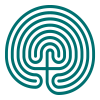
Labyrinths are among the most ancient and powerful of magical tools.  As I work with them, in my personal practice and as a coordinator of community labyrinth walks, I have found myself wondering whether they are aligned with the North/Earth, or the Center where all things come together and are transformed.  Sometimes they seem to be one, sometimes the other, and sometimes both.

 Most of all, the labyrinth seems to be a tool of Mystery, which is anchored in the Earth.  They are rock art, cave drawings and ancient earthworks.   I sense that the labyrinth is a tool of integration, which we can use to understand multi-dimensional ideas, and to expand our ability to walk between the worlds.  We walk the labyrinth as it floats on the earth plane.   At the same time the labyrinth exists both Above and Below.  We can use it to help us find our way to other realms and realities - and our way back. 

 Working with the Chakras in the 7-Circuit Labyrinth

The labyrinth I use most often is the classical 7-circuit labyrinth.  Often, I walk the labyrinth with an awareness of the connection each of the seven paths has to one of the seven in-body chakras, or energy centers.  Using this practice, the walker can connect with each chakra individually, activating all of their energy centers during the walk.  With practice, the walker will make observations, including the existence of  “blocks” or injuries, and then use that information to heal and balance the chakras. 

This exercise gently requires that the walker spend a significant amount of time attending to the lower chakras (Root, Sex, Solar Plexus) which are most connected to the physicality of the body, because those corresponding paths will be encountered first.  The fourth path, which corresponds to the Heart chakra is walked next, and is a transition to the upper chakras (Throat, Third Eye, and Crown), that are more spiritual in nature.  Exiting the labyrinth, the walker returns to the lower chakras at the end of the walk.  It’s a familiar pattern: ground, do spiritual work, re-ground.  To include this as part of a ritual, or as a piece of work in your personal practice, build small, color-saturated altars at the beginning, and perhaps the end, of each path.  You might also lay colored ribbons along each path.  Use the color that is associated with each chakra for an added visual cue.  This will tell the walker which path they are on and to which chakra the path corresponds.  Assign the paths to the chakras in numerical order from the outside to the inside.   The outermost path corresponds to the first, or Root, chakra, which is Red.  The innermost path corresponds with the 7th, or Crown, chakra, which is Purple.  The Center corresponds to the Divine, Goddess or God. 


 The pattern in which the chakras are walked is not straight from the Root to the Crown.  Rather, the path corresponding to the 3rd chakra is the first one walked – suggesting that Will is exercised in making the decision to walk.  The pattern for walking the paths is quite interesting, and has provided me with many hours of meditation.  It is (on the way in) 3-2-1-4-7-6-5-8 (Solar Plexus, Sex, Root, Heart, Crown, Third Eye, Throat, Goddess). 

 Working with Chakras and Elements in the 11-Circuit Labyrinth

 Last August, I facilitated the building of an 11-circuit classical (or Cretan) labyrinth at a Quaker camp in northern Ontario.  Through my reading, I’d learned that in Scandinavia, the 11-circuit labyrinth is quite commonly found on rocky shores. In fact there are hundreds of stone labyrinths along the coastlines of Sweden and Finland.  I think there may be something important, that we don’t yet know, that compels people to build 11-circuit labyrinths at more northern latitudes.  Adding a second “L” or chevron in each corner makes the seed pattern for the 11-circuit labyrinth. 

 This seed pattern overlays in an interesting way over the magic square of 49, which is traditionally associated with the planet Venus. (The 7-circuit labyrinth is connected, via the magic square of 25, to Mars.)  Because of its energetic connection to Venus, I think it is possible that the 11-circuit labyrinth may exude a peaceful, loving energy. 

I wanted the participants of the workshop to experience the connection of the paths with their chakras, so after some experimentation on paper, I set up a walk using color-coded altars at the beginning of each path, and ribbons along the length of each path to subtly identify the paths to the walkers.  In addition to the seven in-body chakras, I assigned a path to each of the four elements.  Depending on whether the elements are the outside paths or the inside paths, the pattern for walking is altered, and I have not developed a sense for which I prefer.  For this particular walk, I put the elements on the inner circuits.   Most of the people at this workshop had never worked with their chakras or the elements.  Before the walk, I led them in a Tree of Life grounding meditation and included an activation of each chakra.  That gave them enough information so they responded to the messages the altars and ribbons were giving them as they walked.  My father, one of the walkers that day, told me afterward that he had never before felt so connected to the Earth and the Divine as he had during that meditation and walk.

The numerical order for walking the 11-circuit labyrinth is 5-2-3-4-1-6-11-8-9-10-7-12 (12 being the center).


Assigning the elements to the outside paths or the inside paths, the patterns are walked in the following orders:


Elements Outside                                         Elements Inside

5-Root Chakra (Red)                           5-Throat (Blue)

2-Fire                                                              2-Sex (Orange)

3-Water                                                          3-Solar Plexus (Yellow)

4-Earth                                                           4-Heart (Green)

1-Air                                                                1-Root (Red)

6-Sex Chakra (Orange)                                6-Third Eye (Indigo)

11-Crown (Purple)                                        11-Earth

8-Heart (Green)                                             8-Air

9-Throat (Blue)                                              9-Fire

10-Third Eye  (Indigo)                                   10-Water

7-Solar Plexus (Yellow)                                7-Crown (Purple)

12-Goddess                                                  12-Goddess

As I work more with this labyrinth, I hope that these patterns will reveal some additional information or connections.  Are they astrological?  Musical?  I don’t know.

 Working with Giving and Receiving in the Labyrinth

Several years ago I began incorporating another piece of work into my labyrinth walks.  I’d been meditating in an effort to learn about “Receiving What Is Offered”.  What began as an effort to be more psychically receptive grew into something quite exquisite, and continues to expand my understanding of the process of Receiving.  Walking the labyrinth, I often found myself holding my cupped hands in front of me, in a posture that to me meant I was ready to Receive.  Soon I felt compelled to walk while carrying an empty bowl.  I WAS the vessel I carried.  Before long I realized that the posture I was using for Receiving was the same posture I might use for “Giving” or “Offering”.  As I walk the labyrinth with my empty bowl, Receiving and Offering, it seems to me a seamless act of Being.  This is very similar to the Breathing Practice that many of us share as an expression of our relationship to the plants.  We breathe in with gratitude for the very oxygen in the air, and we breathe out with love, exhaling carbon dioxide for the plants to breathe.  I’ve come to think of both of these seamless acts as Service.  When I am clear and in the moment, Receiving and Offering becomes a continuous sustainable circuit of moving energy.  The sense that Giving and Receiving are two separate, and even opposite, acts falls away and I can feel that that it is one act of balance.  And – this is thrilling to me – one is not sustainable without the other.  We can no more give without receiving than we can exhale without inhaling.  Many of us try to give and give, denying ourselves, thinking ourselves generous, but eventually we will deplete ourselves.   Learning to Receive will heal us. 

We live in a culture that is, in many ways, based on a false dualistic Either/Or paradigm.  We are taught us to understand the world around us by defining each thing and then separating ourselves from it.  In the Reclaiming Tradition, we are practicing a religion that utilizes a more inclusive Both/And model for understanding the Universe and Beyond.  This viewpoint allows us to understand All That Is by aligning and integrating with all that exists.  The labyrinth is a tool that can help us to understand in our bones, perhaps even on a cellular level, how it is that Both/And works.  The labyrinth can assist us as we make a global paradigm shift away from dualism, to an integrated and interconnected understanding of all that is.

 Copyright, 2000, Sarah C Campbell


Return to TOP


Home, About Us, Products, Classes/Workshops, What's New, Labyrinths, Musings & Articles, Rustlings & Rumors, Questions & Answers, Recipes & Instructions, Links,

Herbs from the Labyrinth, LLC
Sarah Campbell,9 W Grant St, Lancaster, PA 17603
717-290-1517; FAX: 717-396-7768;


Hosted by The Herbal Connection